
Why Ball Mastery Matters More Than You Think (And Some Drills to Develop It)
If I could give every young player one piece of advice, it would be this: spend more time with the ball at your feet. Not shooting. Not running. Just you and the ball, building the kind of comfort and control that makes everything else in football easier.
That might sound simple — maybe even boring – but ball mastery is the foundation that every other skill in football is built on. Without it, a player will always have a ceiling on how far they can develop. With it, the rest of their game opens up in ways most parents don't expect. For players in Melbourne — especially those working towards NPL or A-League academy pathways — this foundation becomes even more important.
Pepijn Lijnders, who has coached at Porto's academy, served as Jürgen Klopp's assistant at Liverpool, and is now assistant to Pep Guardiola at Manchester City, has been vocal about this throughout his career: "I notice that many coaches still think that training technical skills can only be done during a warm-up or that it is only a small part of a larger whole. This thought process must be eliminated. Technique is the basis of everything."
Key Takeaways
Ball mastery underpins every other football skill — without it, advanced development stalls
When ball control becomes automatic, the brain is freed up to focus on decision-making, reading the game, and executing other actions (passing, shooting, etc.)
A 10-minute ball mastery session can deliver more quality touches than an entire team training session
It's trainable at any age and can be practised at home with just a ball and a few cones
Confidence on the pitch comes from competence — players who trust their touch play with more freedom and develop faster
What Ball Mastery Actually Is
Ball mastery isn't juggling. It isn't doing tricks. And it isn't something you either have or you don't.
I think about it as manipulating the ball — making it do exactly what you want it to do, rather than reacting to each touch. The better you can manipulate the ball with every part of your foot, and with both feet, the more options you have. The best players are in full control of the ball. They dictate where it goes. The not-so-strong players are the opposite — they're reacting to their own touches as if the ball has surprised them. They're dragging it under their feet, trying to make it keep up with them when they run, reaching out after a loose touch, constantly a half-second behind. The gap between "I'm controlling the ball" and "the ball is controlling me" is what ball mastery closes.
Why Ball Mastery Is the Key to Everything Else
Ball mastery isn't just about having a nice touch — it's about what it unlocks in the rest of your game.
Research in sports cognition consistently shows that when a motor skill becomes automatic, the brain's cognitive resources are freed up for higher-order tasks like decision-making, spatial awareness, and tactical processing. A study published in Frontiers in Psychology examining cognitive processes in elite soccer found that elite players are able to execute technical actions with minimal conscious attention, allowing their cognitive resources to focus on reading the game and selecting the right action (Vestberg et al., 2024).
In practical terms, this means a player with strong ball mastery doesn't have to think about controlling the ball. Their brain is free to scan for teammates, track defenders, identify space, and make decisions — all while the ball stays at their feet. A player without ball mastery is doing the opposite: their brain is consumed by "don't lose the ball," and there's no bandwidth left for anything else.
Think about driving a car. When you first learned, every action required conscious thought — checking mirrors, steering, changing gears, watching the road. It was overwhelming. But after thousands of hours, those actions became automatic, and now you can drive while holding a conversation, planning your route, and reacting to unexpected situations simultaneously. Ball mastery works the same way. The repetitions build neural pathways that make ball control instinctive, freeing the player's mind for the cognitive demands of the game.
This is why the best decision-makers in world football — Messi, Pedri, De Bruyne — all have exceptional ball mastery. Their technique is so automatic that their brain is entirely focused on the tactical picture. It's also why, as I discussed in my post on what academy scouts look for, technical ability under pressure is consistently rated as the number one attribute scouts prioritise. Ball mastery is how you build that ability.
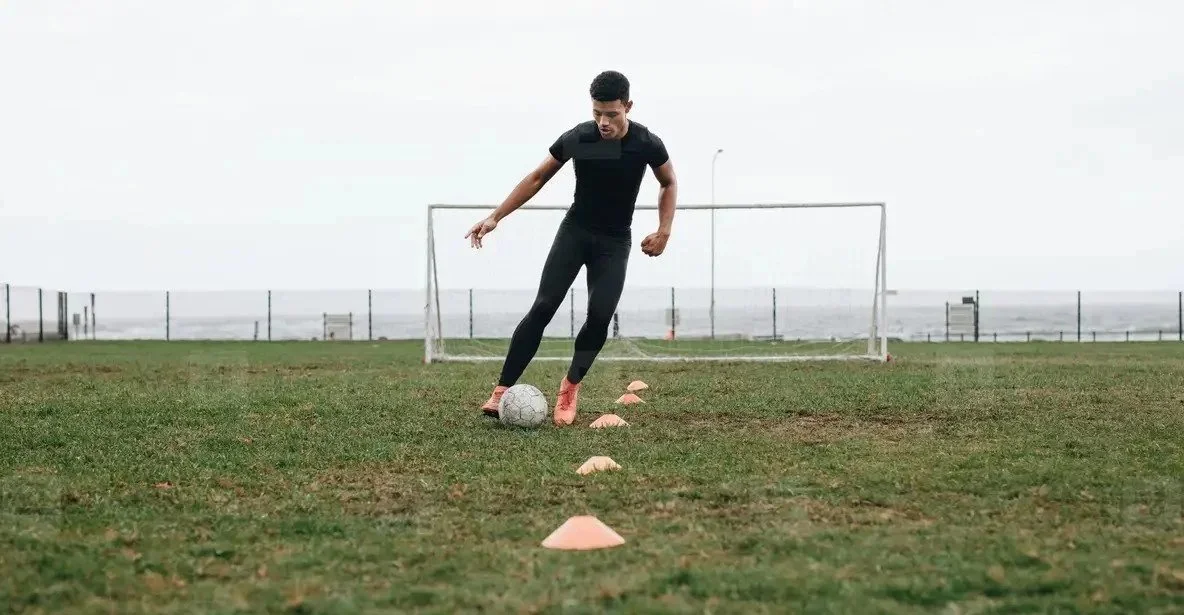
Beyond decision-making, ball mastery is what allows players to operate in tight spaces and come out with the ball. If you're truly in control of your touches, you can hold possession under pressure, shift the ball quickly, and escape defenders — even when space is limited. This is exactly what shows up in 1v1 situations: the players who can manipulate the ball instinctively are the ones who create separation and beat defenders consistently. I break this down in more detail in my guide to 1v1 dribbling.
The more comfortable a player is with the ball at their feet, the more complete the rest of their game looks — almost immediately. I see other areas of players' games improving all the time after their ball mastery improves, even in areas you wouldn't expect to be so directly connected. A player's passing gets better — not because we've drilled passing technique specifically, but because they're now able to set the ball into a comfortable position before they pass, and they can focus on the quality of the pass itself instead of scrambling to control it first. It's a chain reaction.
Ball mastery isn't optional — it's a requirement. You will not make it to the top without being elite at controlling the ball with your feet. It is the basis of our game. Some players at the top level might look like they don't do much with the ball — centre-backs, target strikers — but if you watched most of these players in training, or saw them play against slightly lower opposition, you'd quickly realise that even the least "finesse" players at the professional level have an excellent ability with the ball at their feet.
"But That Never Happens in a Game"
One of my players once asked me why we were dribbling through a straight line of cones. "That never happens in a game," they said. I loved the question — I always want my players to understand the why behind what we're doing, not just follow instructions blindly.
My answer was this: you're right, you'll never dribble in a straight line through cones in a game. But that's not the point. The point is to get your feet so comfortable manipulating the ball — with every surface, in every direction, at speed — that when you are in a game and a defender is closing you down, or you need to shift the ball quickly to create a passing angle, or you receive in a tight space and need to control it instantly, these movements become second nature. The cone work is one way we can build them. The game is where you apply them.
This is not the only type of dribbling work we do — far from it. But it is a foundational block. We build ball mastery through repetition in a controlled environment, then layer on complexity: adding pressure, adding decision-making, adding game-realistic scenarios. But if the foundation isn't there, everything built on top of it is shaky.
The Touches Gap
Here's something most parents don't realise: in a typical team training session with 20+ players, your child might get a few hundred touches on the ball — and most of those aren't being actively coached or corrected. In a game, it's even fewer.
Compare that to a focused 10-minute ball mastery session, where a player can accumulate hundreds of quality touches. Every touch is building the muscle memory that makes ball control instinctive. This is also why private coaching makes such a significant difference compared to team training alone — in a 1-on-1 session, every touch is intentional, observed, corrected, and refined.
The players who invest 10–15 minutes of ball mastery work at home between sessions are the ones who improve fastest. It's not glamorous, and it doesn't feel like "real football." But it's arguably the most efficient use of training time a young player can make (see my post on how often kids should be training to hear more).
Ball Mastery Drills You Can Do at Home
One of the best things about ball mastery is that all you need is a ball, a flat surface, and a few cones.
Setup: Place 8–10 cones in a straight line. For spacing, I place one foot in front of the other and put the next cone down (2 feet longways) — that gives you roughly the right distance. Start wider if you're a beginner and bring them closer as you get more comfortable. At each end of the line of 8-10 cones, place another cone about 5 metres away. This is your acceleration cone — once you've navigated the tight cones, you accelerate out to this cone, dribble around it, then accelerate back and get the ball under control as you re-enter the tight cones heading the other way. Do each skill a minimum of 4 laps (up and back is one lap) — but the more reps, the more comfortable you'll get.
Here are some of my favourites that I use regularly in my sessions:
1. Inside Outside (Both Feet) — Builds comfort switching the ball between feet at speed, using inside and outside surfaces alternately.
Inside touch to outside touch ball mastery drill at CD Private Soccer Coaching session in Melbourne.
2. Inside Outside (Single Foot) — Develops coordination on one foot, using the inside and outside of the same foot to weave through.
Inside touch to outside touch with one foot ball mastery drill at CD Private Soccer Coaching session in Melbourne.
3. Lateral Roll to Inside Touch — Improves sole-of-foot control and the ability to shift the ball laterally before redirecting forward.
Lateral roll to inside touch ball mastery drill at CD Private Soccer Coaching session in Melbourne.
4. Outside Touch to Three Inside Touches — Builds rhythm and close control through a combination of outside and quick inside touches.
Outside touch to three inside touches ball mastery drill at CD Private Soccer Coaching session in Melbourne.
5. Sole Pull to Inside Lateral Touch to Inside Touch Forward — A more advanced combination developing multi-directional control and quick changes of direction. Mimics an effective 1v1 skill – ‘La Croqueta’.
Sole pull to inside touches ball mastery drill at CD Private Soccer Coaching session in Melbourne.
6. Sole Roll Across to Two Toe Taps — Develops sole control and quick feet, combining a lateral roll with sharp toe taps.
Sole roll and toe taps ball mastery drill at CD Private Soccer Coaching session in Melbourne.
7. Outside Touch to Sole Roll Back Across — Builds the ability to shift direction using the outside of the foot and sole in combination.
Outside touch to sole roll ball mastery drill at CD Private Soccer Coaching session in Melbourne.
Start slow. Get the technique right before adding speed. Once you can do each skill cleanly at walking pace, gradually increase to jogging pace, then match speed.
Focus on the details — make every touch intentional. Every player has ones that come easily and ones they struggle with, so don't get discouraged. Put in the practice and you will get better — I'm yet to see a player who doesn't when they invest the time.
Once you're comfortable with these movements through the cones, the next progression is to take them into a less structured environment. Set up a box — roughly 8 to 10m square — with a few cones scattered randomly inside as obstacles. Now instead of practising each skill in isolation through a straight line, you're combining them: inside-outside into a roll touch, dribble around a cone, then a pull-inside-inside around another obstacle, and so on. Get creative — freestyle it. This is where you start chaining movements together the way you'd actually use them in a game, reacting to what's in front of you rather than following a set pattern.
Ready to Build Your Foundations?
Ball mastery is where I start with every new player, regardless of their age or level. Before we work on 1v1 moves, before we work on passing under pressure, before we work on game intelligence — we make sure the foundations are solid.
The players who invest in ball mastery now — whether they're 8 or 16 — are the ones who will have the technical platform to keep developing long after their peers have plateaued.
Based in Melbourne, I offer a free trial session so you can see what focused, individual development looks like. Get in touch to book yours, or visit cdprivatesoccercoaching.com.au to learn more.
FAQ
What is ball mastery in soccer?
Ball mastery is the ability to control and manipulate the ball confidently using all parts of both feet. It allows players to keep possession under pressure and execute skills quickly without needing to think about each touch. Strong ball mastery is the foundation of all technical development in soccer.
How can kids improve ball control at home?
The most effective way is through short, consistent ball mastery drills done in a small space. Simple soccer ball control exercises — like inside-outside touches, sole rolls, and cone dribbling — can be practised for 10–15 minutes a day and lead to rapid improvement.
How often should you practise ball mastery drills?
Ideally, players should practise ball mastery drills 4–6 times per week, even if sessions are short. Consistency matters more than duration — regular repetition builds the muscle memory needed for confident ball control in games.
At what age should players start ball mastery training?
Players can begin developing ball mastery as early as 5–6 years old, and it remains important at every stage of development. The earlier players build strong ball control habits, the easier it is for them to progress into more advanced skills later on.
Does private soccer coaching help improve ball mastery faster?
Yes — private coaching significantly accelerates development because players get more touches, immediate feedback, and targeted correction. Compared to team training, it allows coaches to focus specifically on improving ball mastery and overall technique in a much more efficient way.
References
Vestberg, T., et al. (2024). Cognition in elite soccer players: A general model. Frontiers in Psychology. https://doi.org/10.3389/fpsyg.2024.1477262