
What Do Professional Academy Scouts Actually Look For? An Insider's Perspective
Most parents think they know what academy scouts look for. Speed. Goals. Being the best player on the team. I hear it constantly — "my son scored 30 goals this season" or "she's the fastest player in her age group."
I understand why parents think this way. It's what's most visible from the sideline. But after years spent identifying talent professionally, I can tell you that the attributes scouts actually prioritise often look very different from what most families expect. My experience includes working as a Scout and Recruitment Analyst for Plymouth Argyle F.C. in the English Championship, where my job was specifically to assess whether A-League players had the profile to make the leap into elite European football. Here in Australia, I've also been directly involved in identifying and recommending junior players into A-League academy programs, and continue to do so today.
Through this work I've developed a clear picture of what scouts at every level are genuinely looking for — and several peer-reviewed studies I will reference throughout (Bergkamp et al., 2022; Fuhre et al., 2022; Jordet et al., 2020; Larkin et al., 2016), both confirm what I've seen first-hand and challenge many of the assumptions parents make.
Key Takeaways
Technical ability is consistently rated as the #1 attribute by professional scouts — ahead of tactical, mental, and physical factors
Decision-making ability was one of the strongest differentiators between selected and non-selected players in youth football research
Mental factors like coachability, attitude, and resilience rank alongside technique as top identification criteria — ahead of physical attributes
Height, size, and other physical measures are of secondary importance to top level coaches and selectors at the youth level
The things parents typically focus on — goal tallies, speed, highlight reels — are among the least valued by scouts
1. Technical Ability — The Non-Negotiable
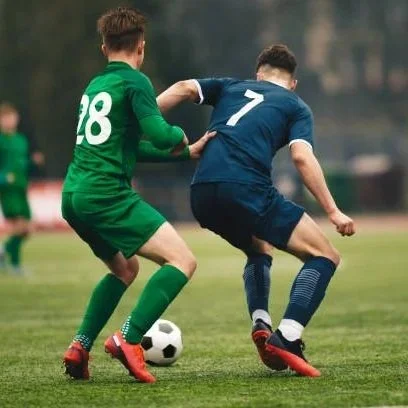
Player controls ball under pressure from opponent.
Every young player can look comfortable on the ball in an unopposed drill. Scouts want to see whether a player can execute their technique under pressure — when being closed down, in a fast-paced game, or when the outcome matters.
Multiple peer-reviewed studies confirm this — scouts consistently rate technical ability as the single most important attribute, ahead of tactical, mental, and physical factors (Bergkamp et al., 2022; Fuhre et al., 2022). Meanwhile, these studies found physiological factors were secondary and measures like height and size were considered the least important.
By technical ability I am referring to a player’s ability to control and manipulate the ball. Their touch, passing, dribbling (see my post on 1v1 dribbling), shooting, among other things. This means scouts are looking for things like a clean first touch when a defender is on your shoulder, an ability to receive and play forward under pressure, not just sideways or backwards, and clean, consistent ball-striking that holds up even when you're tired.
Last year I was scouting an A-League player for a potential move overseas. He had a lot of impressive attributes — size, speed, a powerful shot — but his first touch quality was lacking. And while his other abilities made up for this in the A-League, it was clear he'd struggle in more competitive leagues. The gap between having technique and not having it becomes brutally obvious as the level rises.
To take an even more extreme example: you may remember Usain Bolt, the world record holder for the 100m sprint, actually playing a few practice matches for Central Coast Mariners in 2018. Well, it turned out that even being literally the fastest man on the planet is not enough to cover for sub-elite technical ability. He failed to secure a contract, and his footballing career was over before it really started.
2. Game Intelligence — The Biggest Differentiator
This is the attribute that separates good players from academy-level players more than any other — and the research confirms it.
A study on talent identification in Australian youth football (Larkin, O'Connor & Williams, 2016, published in the European Journal of Sport Science) found that perceptual-cognitive skills — specifically decision-making ability — were one of the strongest differentiators between players selected for elite national development programs and those who were not.
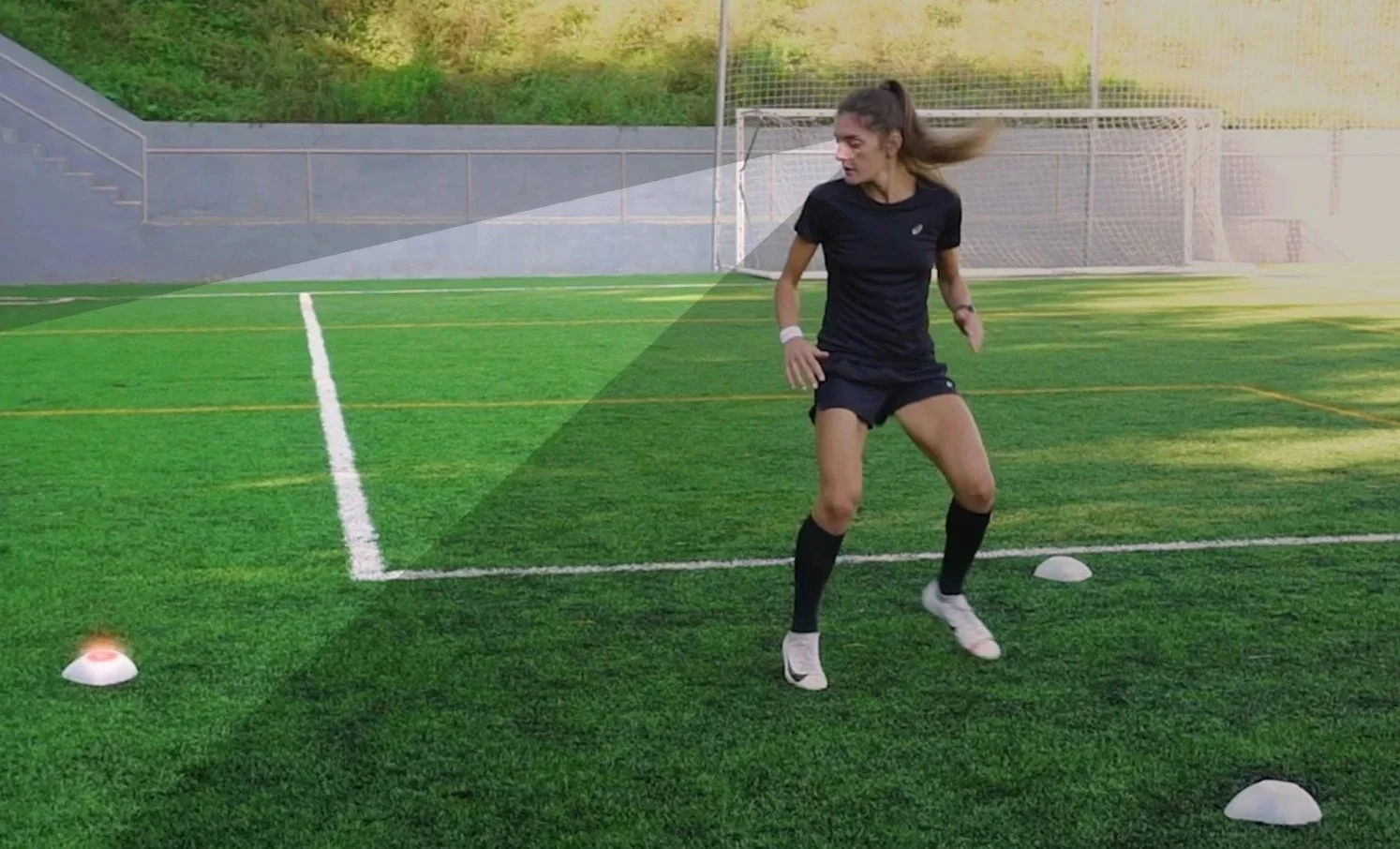
Player scans before receiving the ball in training.
In practical terms, scouts are watching for players who scan before they receive the ball (in my video analysis sessions players are almost always surprised by how little they actually scan when they see it on screen), who recognise space quickly, who make decisions with purpose and forward intention. A player who receives the ball and then looks up to decide what to do is already too late. Scouts want to see players who have already decided what to do before the ball arrives. And just as importantly, scouts want to see players who more often than not are making the right decisions (passing if they have a teammate in a better position, dribbling only when appropriate, playing forwards if possible, etc.). Football is played between the ears as much as with the feet.
When it comes to scanning and processing that information to make good decisions, one of the best examples of this in action comes from Dr Geir Jordet's research at the Norwegian School of Sport Sciences. Jordet has spent over 20 years studying scanning behaviour in professional footballers, measuring how frequently players look away from the ball in the 10 seconds before receiving a pass. His data revealed that Xavi came out on top with a scanning frequency of 0.83 scans per second — an average of 8.3 scans in the 10 seconds before receiving the ball. You may recognise some of the other names near the top of Jordet's data: Fábregas (0.76), Gündoğan (0.66), Lampard (0.62). The hierarchy was clear: high-level players scanned between 4 and 6 times, and the absolute stars of European football scanned between 6 and 8+ times.
This is one of the reasons I dedicate a significant portion of every coaching session to decision-making under pressure, using high-intensity, mentally stimulating scenarios that force players to scan, process, and act with purpose. If you've trained with me, you know how much emphasis I put on this. So much so that one of my player's parents actually bought him a VR headset to practise scanning — check out the application Be Your Best if you want to see what I'm talking about. Very cool.
3. Coachability, Attitude, and Mental Resilience
This one might surprise some parents, but scouts pay close attention to how a player responds to instruction, setbacks, and pressure.
Arguably the first thing I notice about a player is their mental approach to the game. A big part of this is how they handle setbacks – mistakes, poor referee decisions, adversity – and whether they recover mentally or let their heads drop. Things like their attitude, work ethic, and determination can be just as important as technical skill. Research backs this up: mental factors rank alongside technique and tactics as the most important identification criteria, ahead of physical attributes (Fuhre et al., 2022).
Why is this so important? For starters, nothing ever goes completely your way in a game as unpredictable and competitive as soccer. Every team and individual faces setbacks, and if you can’t deal with them, or use them as motivation, you simply will not survive at the top level. But just as importantly, the reality is that no player is ever the finished article when they're scouted or accepted into a high-performance academy. Coaches need to be confident that they're bringing in a player who is coachable and willing to learn. They want to make you a better player, but that's not entirely up to them — the player’s attitude, including how they conduct themselves at training, is a defining factor.
As a coach, I've had parents come to me about their children, talking about difficulty with club coaches or not getting accepted at trials, despite feeling like their son or daughter was as good as — if not better than — the other players. But coaches are considering a lot more than skill when assessing players. You give attitude when a coach puts you somewhere other than your preferred position? You're difficult to deal with during sessions? You don't take on feedback? You drop your head when things get hard? These are all huge red flags. Ask yourself honestly: are these the behaviours that elite environments are looking for? I’ve had players that, after a period of trying to address these shortcomings, I've stopped working with when their attitude hasn't improved. Sadly, these are the players that get left behind. Don't let this be you.
The flip side is equally true. If you demonstrate high levels of coachability, coaches will be excited to work with you — and that's a huge advantage. Just as I’ve seen technically gifted players overlooked because of issues in this area, I've also seen less naturally talented players earn opportunities because they showed a willingness to learn, a strong work ethic, and mental resilience.
4. Physical Profile — Important, But Not What You Think
Yes, physical attributes matter. But not in the way most parents assume.
The Norwegian study (Fuhre et al., 2022) was clear: physiological factors were considered secondary to technical, tactical, and mental attributes, and anthropometric measures (height, body size) were ranked as the least important criteria by coaches and selectors.
What scouts are actually looking at physically is how a player moves — their agility, balance, coordination, ability to change direction, and body control in tight spaces. They're looking past the current physical snapshot and assessing whether a player's physical profile can develop over time — research suggests scouts who observe players aged 12 and under recognise they can't reliably predict future performance until around age 13.6 on average (Bergkamp et al., 2022).
Speed does matter in the modern game — but it's nowhere near the top of the list on its own. Agility and movement quality are valued more highly than straight-line pace at the youth level.
With my younger players, I start by looking at simple things. Are they on their toes instead of landing flat-footed when sprinting? Are they balanced? Can they make sharp changes of direction? Think about a time you've watched a top-level player at any age. It often looks effortless — like they're gliding around the field while everyone else is running through sand. That's no coincidence. The best players are balanced and move freely. It’s important not to confuse this with being the strongest or fastest. Players who rely on early physical advantages often find that once their peers catch up developmentally, their main edge has disappeared.
By working on the fundamentals with many of my players — players who would have openly admitted they were lacking physically — we've been able to advance their movement, balance, and overall physical profile to the point where, once they did develop, they were far beyond any player who hadn't given this the attention it requires.

Ladder and agility work to improve soccer-specific movements.
One of my favourite examples is Josh Nisbet. Standing at just 158cm tall — officially the shortest player to ever grace the A-League — he was written off by many due to his physical profile. That is, until he played a pivotal role in Central Coast Mariners' 2022/23 A-League Championship and their historic 2023/24 treble (Premiership, Championship, and AFC Cup), won the Mariners Medal in 22/23 as the club's best player, the 23/24 Johnny Warren Medal as the league's best player, made the PFA Team of the Season, earned a Socceroos call-up, and secured his dream move to Europe. Size? No. High work rate? Agility? Balance? Explosiveness? Yes. Yes. Yes. Yes.
This is exactly the kind of movement quality I work on with my players across Melbourne — and it's what local academy scouts are watching for too.
5. What Scouts Don't Care About (As Much As Parents Think)
Let me be direct about a few things that parents often overvalue:
Goal tallies. Scoring 30 goals in a weak competition tells a scout nothing about a player's ceiling. I want to see how a player performs against quality opposition, not how they dominate a game where they're clearly the best on the pitch (see my post on NPL vs community soccer to learn more about the levels of competition).
Being the biggest or fastest right now. As touched on, the research consistently shows that physical and anthropometric attributes are ranked lowest in talent identification criteria. Scouts know that early physical advantages often disappear as players mature.
Highlight reels. Highlight reels showcase moments of brilliance but don't capture a player's overall potential. Scouts need to watch full matches to see what a player does without the ball, how they respond to losing possession, and how they behave when the game isn't going their way.
I get it — things like goals, an impressive mazy run, or a nice skill move are what attract attention. But these headline moments actually reveal very little about the overall quality of a player. Maybe to score that goal, the player missed five other chances, three of which they should have passed off to a teammate in a better position. Maybe that impressive dribble was their tenth attempted dribble of the match, and had they looked up when receiving the ball, they would have seen several better passes. Remember: scouts are thinking about the future, and overall quality is far more important than moments.
So What Can Your Child Actually Work On?
The attributes scouts are looking for — technique under pressure, game intelligence, coachability, physical sharpness — are all trainable. But they're difficult to develop in a team training environment alone, where there are often 20+ players and one coach, and session time is limited.
This is where focused, individual coaching makes a real difference. In a 1-on-1 or small group session, every repetition is purposeful. Feedback is immediate and specific. The session is tailored entirely to what that player needs to improve.
Players I've worked with have gone on to earn places at Melbourne Victory Academy, Melbourne City Academy, Football Victoria Academy, Western United Academy, and the Emerging Matildas. That's not a coincidence — it's the result of targeted, high-quality training that develops exactly the attributes scouts are looking for.
Ready to Start?
If your child is serious about reaching the next level, a structured private coaching program can accelerate their development in ways team training alone can't.
I offer a free trial session so you can see the difference first-hand. Get in touch to book yours, or visit cdprivatesoccercoaching.com.au to learn more.
Sources Referenced
Bergkamp, T.L.G., Frencken, W.G.P., Niessen, A.S.M., Meijer, R.R., & den Hartigh, R.J.R. (2022). How soccer scouts identify talented players. European Journal of Sport Science, 22(7), 994–1004.
Fuhre, J., Øygard, A., & Sæther, S.A. (2022). Coaches' Criteria for Talent Identification of Youth Male Soccer Players. Sports, 10(2), 14.
Jordet, G. et al. (2020). Scanning, Contextual Factors, and Association With Performance in English Premier League Footballers. Frontiers in Psychology, 11, 553813.
Larkin, P., O'Connor, D., & Williams, A.M. (2016). Talent identification and selection in elite youth football: An Australian context. European Journal of Sport Science, 16(7).