
The Art of 1v1 Dribbling: How to Beat a Defender with Skill, Not Just Speed
Here's something I see constantly with young players: they get the ball, put their head down, and try to sprint past the defender. Sometimes it works — especially when they're faster than everyone else at their age group. But here's the problem: that stops working. As players get older, defenders get quicker, stronger, and smarter. The player who relied on pace alone suddenly can't beat anyone, and they don't have the skills to fall back on.
Johan Cruyff put it perfectly: "Speed is often confused with insight. When I start running earlier than the others, I appear faster." The best dribblers in the world don't beat defenders because they're the fastest player on the pitch. They beat them because they understand the principles behind 1v1 play — body feints, changes of pace, attacking the right space at the right time — and they've practised these skills until they're instinctive.
Key Takeaways
Speed alone is a dead end — the best dribblers beat defenders with changes of pace, body feints, and attacking space, not raw speed
Understanding the principles behind 1v1 dribbling is more important than memorising a catalogue of skill moves
Knowing when to dribble is just as important as knowing how — the best players pick their moments
Practice. Practice. Practice. You cannot grow as a player if you're afraid to try — being willing to lose the ball is essential for development
Master 2–3 go-to moves rather than trying to learn 20 — consistency under pressure beats variety
Why Speed Alone Stops Working
Every junior coach has seen it: the fast kid who dominates at U10s because they can simply outrun everyone. But by U14 or U15, the other players have caught up physically, and suddenly that speed advantage has evaporated. If the player hasn't developed the technical skills to beat a defender with skill rather than pace, they can fall off dramatically.
Players regularly come to me having relied on their athleticism for years, and now they're stuck. They don't know how to manipulate a defender, how to sell a fake, or how to create space with a change of direction rather than a change of gear.
The first thing I do in these cases is force the player to rethink the role of speed within the dribble. Speed isn't the move — it's the finishing touch. We go back to the foundations: how to manipulate the ball to suggest you're going one way, how to drop a shoulder convincingly, how to use changes of speed rather than flat-out sprinting. Once those technical skills are in place, the acceleration that has always been there suddenly has a purpose. Instead of trying to outrun defenders, wrong-foot them first and then explode past.
The key is always building around the ball. If your technique is clean and you understand the basic principles — the shoulder drop, the change of pace, reading the defender — then you can back yourself in any 1v1 situation. Speed becomes the weapon you use after the skill, not instead of it.
The reality is that the best dribblers in the world — players like Messi, Doku, Neymar — are quick, but that's not why they beat defenders. They beat defenders because they understand how to manipulate a defender's body position, how to exploit the split-second when a defender shifts their weight, and how to change pace at precisely the right moment. These are skills that can be taught and trained.
The Principles Behind 1v1 Dribbling
Before I teach any specific moves, I always start with the principles. If a player understands why moves work, they can adapt to any situation rather than relying on a memorised trick that might not suit the moment.
1. Attack the Defender
This is the principle that most young players get wrong. Too many players receive the ball and freeze, or wait for the defender to come to them. You need to do the opposite — dribble at the defender with purpose. When you attack a defender, you force them to make a decision. And a defender who's reacting is a defender who can be beaten.
The key is to approach under control — not at full sprint. You want to be balanced, on your toes, with the ball close to your feet (ball mastery). If you're sprinting, you can't change direction. If you're controlled, you have options.
Arguably the most important part of the setup is your spacing. Time and again I see attackers getting right on top of the defender before they start their skill. Even if your move is technically perfect, if you're too close when you execute it, the defender can just stick a foot out. Give yourself that extra yard of space to work with.
2. Read the Defender's Body
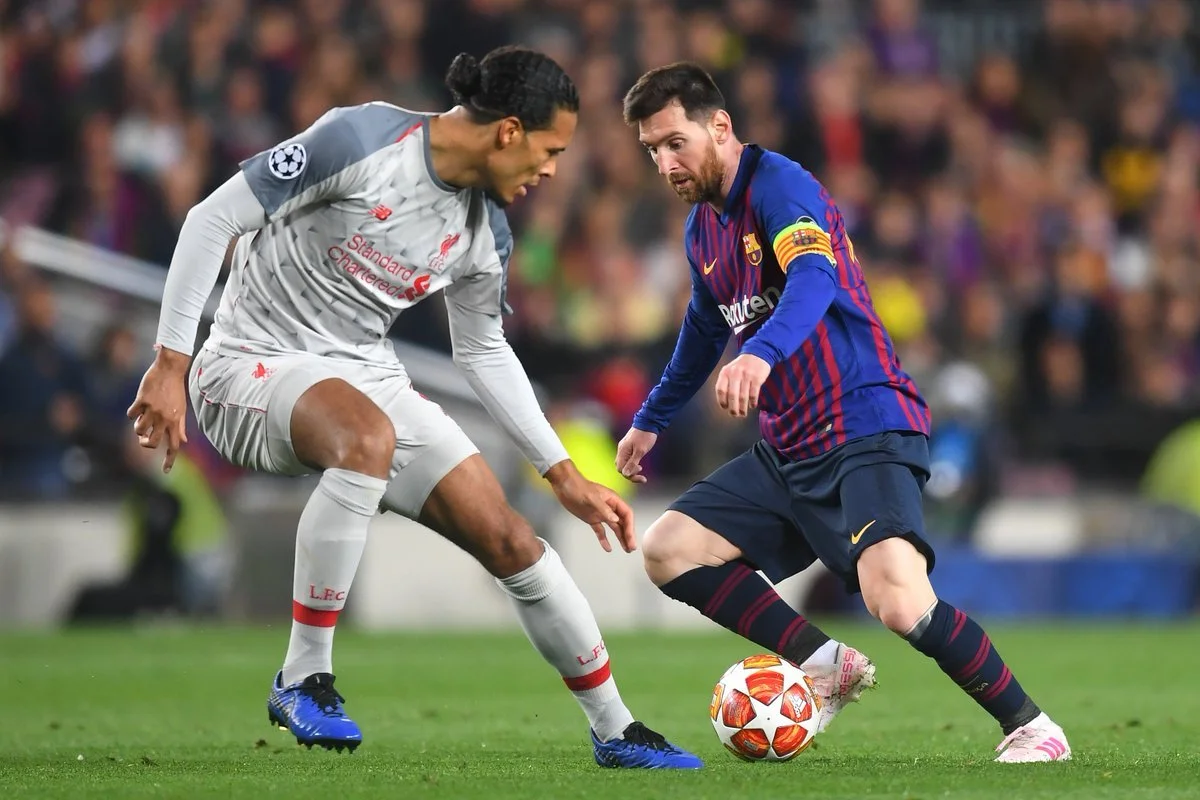
Messi takes on Van Dijk in the Champions League.
Before you make any move, look at the defender. Which way are their hips facing? Which foot is forward? Are they on their toes or flat-footed? This tells you everything you need to know about where they're vulnerable.
A defender whose hips are open to one side is weak to the other side — they physically cannot turn fast enough to recover if you go the opposite way. A defender who's flat-footed is vulnerable to any sharp change of direction, because they can't react quickly from a standing start.
It's worth noting that a good defender will actively position themselves to show you towards the less dangerous space — for example, forcing you wide rather than letting you cut inside. Recognising this is part of reading the defender too. If they're showing you one way, you know where the opportunity is — but you also know what they're expecting.
In my sessions, I get players used to reading the defender before they get to the skill. It ties back to the scanning work I discussed in my post on what academy scouts look for — the best players have already assessed their options before the ball arrives. With 1v1 dribbling, this means looking at the defender's body shape as you approach, not after you've already committed to a direction.
3. Sell the Fake
The move itself is only as good as the setup. A stepover means nothing if the defender doesn't believe the fake. The key is committing your body — not just your feet — to the deception. Drop your shoulder, shift your weight, look in the direction you want the defender to think you're going. The more convincing the setup, the more space the move creates.
4. Explode into the Space
This is where the change of pace comes in — and it's where speed does matter, but only after the skill has done its work. Once the defender has been wrong-footed, you need to accelerate past them immediately. If you hesitate, they recover. The combination of controlled approach, quick move, explosive exit is what makes elite dribblers so effective.
Pep Guardiola described this quality in Manchester City's Jeremy Doku, currently the Premier League's most prolific dribbler: "There is no winger over 5-10 metres stronger than Jeremy... It's incredible how he changes the rhythm in five metres." That change of rhythm — slow to fast, controlled to explosive — is the essence of great 1v1 play.
Hearing It from the Top
If you want to see these principles in action from someone at the very top of the game, I'd recommend watching this interview with Jeremy Doku on the Unisport YouTube channel, where he breaks down exactly how he approaches 1v1 situations. He covers nearly every principle we've discussed — reading the defender, identifying space, maintaining separation, body feints, staying on your toes, and how he found the one or two moves that suited him best and mastered them rather than trying to learn everything.
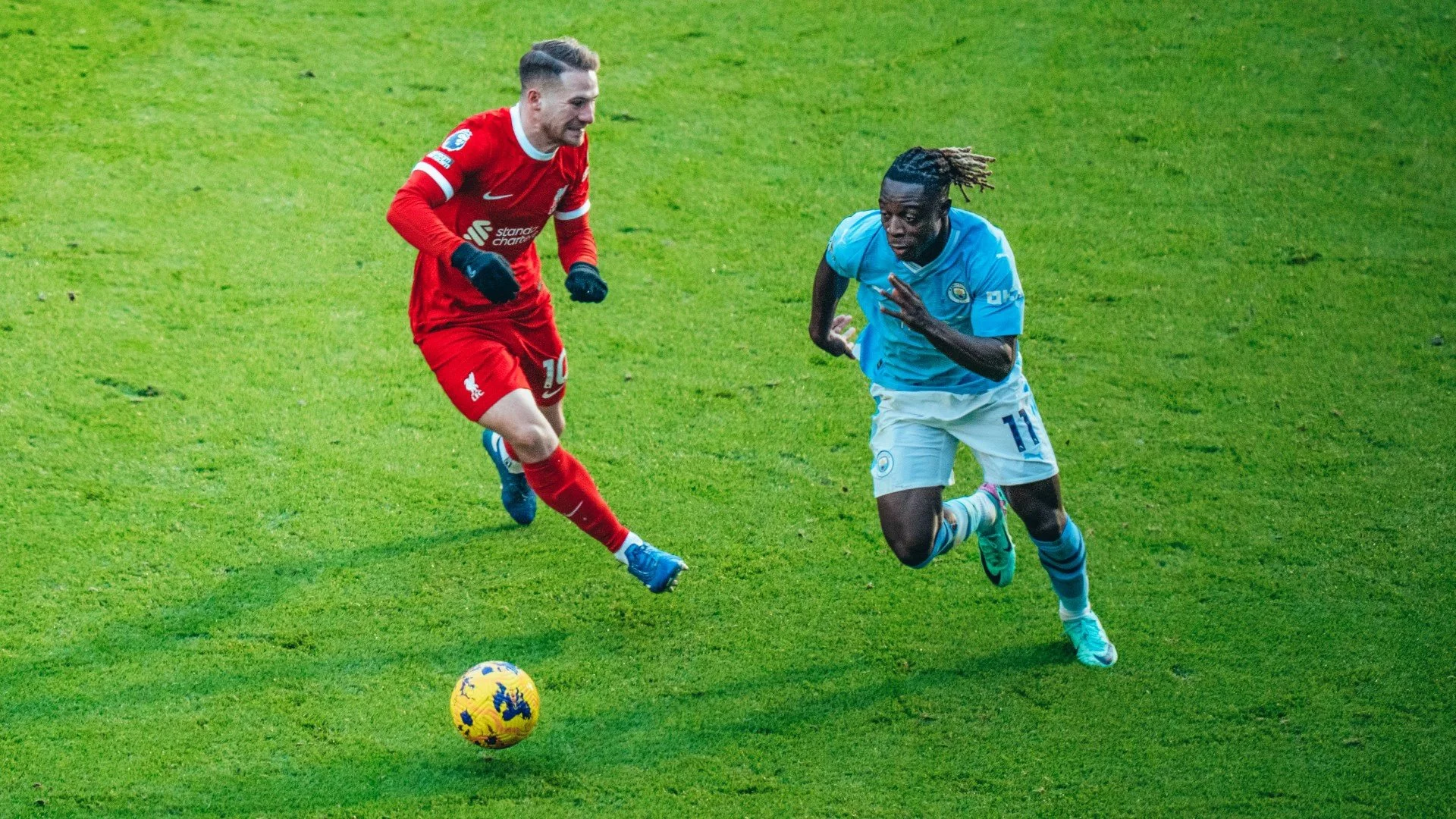
Jeremy Doku accelerates away from Liverpool’s Alexis Mac Allister.
The takeaway for young players is this: the fundamentals don't change whether you're playing U12s in Melbourne or in the Premier League. The principles are the same. The difference is the thousands of hours of practice that make them instinctive.
Understanding the Different Types of 1v1
When people talk about "beating a defender," they usually picture getting the ball from one side to the other and leaving the defender behind. But this isn’t the only use of 1v1 skills.
There's a second type of 1v1 that's just as important: creating an angle past the defender without necessarily getting all the way around them. Think about it — if you're in a shooting position, or looking to find a pass, you don't need to leave the defender in the dust. You just need to create enough separation to get your shot/pass away, or enough of an angle for the ball to travel past the defender and towards your target.
Watch goals scored from 1v1 situations at the top level and you'll notice that a huge number of them come from this second type. The attacker has used a quick shift of the ball, a body feint, or a change of angle to create just enough space for the shot to find the target. Think of Messi, or Arjen Robben (an expert at this), cutting inside from the right and curling the ball into the far post — the defender is often still right there, but the angle has been created.
This distinction matters because it changes what the player is trying to achieve. In a full dribble, you're trying to get past. In an angle-creating 1v1, you're trying to create a window. Both require the same foundational skills (reading the defender, selling the fake, changing pace), but the end product is different. I coach both, because a player who can only dribble past but can't create shooting angles is leaving goals on the table.
5 Moves That Actually Work (And When to Use Each One)
I'm a firm believer that a player is better off mastering 2–3 moves they can execute under pressure than memorising 15 moves they'll forget in a game. That said, here are five of my favourites.
1. The Body Feint (or Shoulder Drop)
How:Drop your shoulder and shift your weight convincingly in one direction, then push the ball the other way with the outside of your foot and accelerate.
When to use it: When the defender is square-on and you need to commit them to one side. This is the most versatile move in football — simple, effective, and it works at every level from U8s to the pros.
Why it works: The defender tracks your body, not the ball. When your shoulder drops, their brain tells them to shift their weight to cover that side. By the time they realise you've gone the other way, you're past them.
2. The Stepover (Scissors)
How:Step over the ball from inside to outside with one foot, then push the ball the opposite way with the outside of the other foot.
When to use it: When you're running at a defender at pace and want to freeze them. The stepover works best as a speed-and-deception combo — the motion of your leg going over the ball gives the defender a false signal about your direction.
Why it works: It disrupts the defender's timing. They see your foot moving in one direction and instinctively shift to cover, but the ball hasn't moved. By the time they correct, you've taken the ball the other way.
3. The Cruyff Turn
How: Shape as if you're about to cross or shoot, but instead drag the ball behind your standing leg with the inside of your foot and turn away from the defender.
When to use it: When you're on the wing and the defender expects a cross. It's devastating because the defender has already committed to blocking the cross — when you pull the ball back, they're completely wrong-footed.
Why it works: The defender sees shooting or crossing body shape and commits. The Cruyff Turn punishes that anticipation and commitment. Johan Cruyff himself made this move famous during the 1974 World Cup, and it remains one of the most effective moves in the game 50 years later.
4. The Inside-Outside (Same Foot)
How: Touch the ball with the inside of your foot in one direction — suggesting you're taking the ball down the line — then quickly use the outside of the same foot to cut the ball sharply across your body in the opposite direction.
When to use it: Think of Jack Grealish driving down the left flank, or Lamine Yamal on the right — the inside touch sells the idea that you're going to continue wide, and the outside cut takes you across the face of the defence. Particularly effective for inverted wingers looking to cut inside onto their stronger foot and curl a shot into the far post.
Why it works: Because both touches come from the same foot in quick succession, the defender has almost no time to react. The first touch commits their weight to one direction, and the second touch takes you the other way before they can recover.
5. La Croqueta
How: Shift the ball quickly from the inside of one foot to the inside of the other, side-foot to side-foot, while changing direction and accelerating away. It's a lateral shift of the ball across your body that takes you past the defender.
When to use it: When you're in tight spaces with a defender right in front of you — particularly in central midfield or around the edge of the box. It's also devastatingly effective when defenders double up on you, as the lateral movement can split two defenders at once.
Why it works: Michael Laudrup, the move's originator, put it best: "La Croqueta is a piece of skill that exists not because it looks nice but because it serves the purpose of setting you up for the next pass." Andrés Iniesta made it his signature at Barcelona and with Spain. It's deceptively simple — just a quick shift from one foot to the other — but the body weight transfer combined with the change of direction makes it incredibly difficult to defend at speed.
These five moves are a starting point — not an exhaustive list. Different players gravitate towards different skills, so I teach a whole range: the Ronaldo chop, Maradona turns, elasticos, McGeady spins, L-cuts, V-drags, and plenty more. The goal is to find which moves each player feels most comfortable with and make those their go-to weapons. Maybe not the Antony "fidget spinner" though...
Knowing When to Dribble (And When Not To)
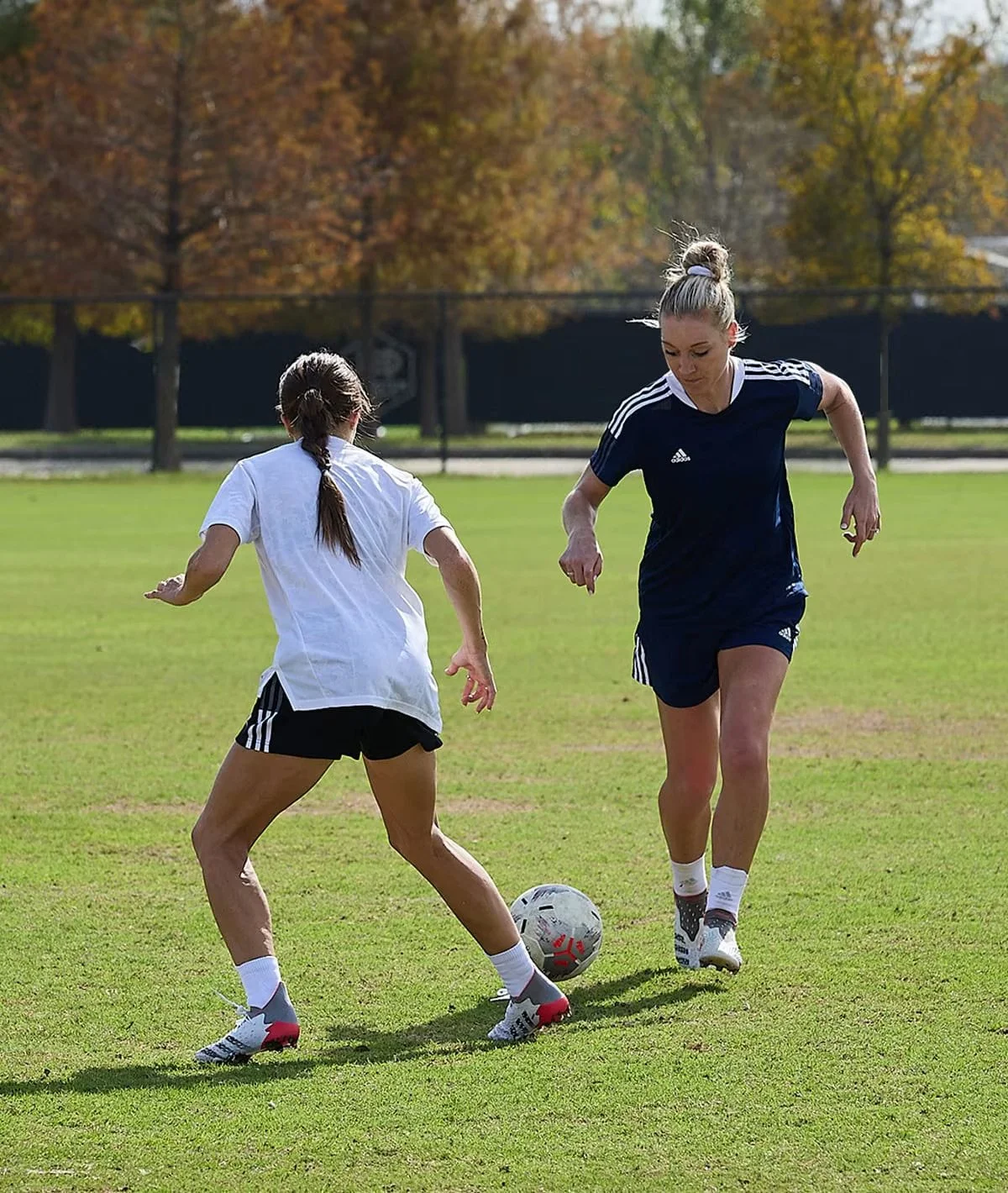
Attacker dribbling at a defender in a 1v1 scenario.
This is the part most "skill move" guides completely ignore — and it's arguably more important than the moves themselves.
The best dribblers in the world don't try to beat a defender every time they get the ball. They pick their moments. Guardiola made this point when talking about dribbling: "I don't like them to dribble 60 metres from goal. But near their box, take a risk, have a dribble, it's your talent."
The principle is simple: the closer you are to the opposition goal, the more reward there is for taking a player on. A winger in a 1v1 on the touchline in the attacking third? Take them on — the worst that happens is you lose the ball in a relatively safe area. A centre-back in a 1v1 just outside your own penalty box? That's not the time. A bad decision there costs a goal.
I teach my players to consider two things before they dribble: what happens if I lose it here and can I find a teammate in a better position? If the answer is "nothing dangerous” and “no”, then back yourself and go. Otherwise, find the pass and move.
We get a lot of reps of this decision-making in our small group sessions. Small-sided scenarios force players to make quick decisions under pressure. For example, in a 2v1 with the defender in front of them — should they take the player on? Probably not, since their teammate should be free and unmarked. But in a 2v2, if they have just one defender on them, that's a 1v1 that — if they're in an attacking area — is absolutely worth taking on. The key is practice and repetition (and review in the form of match video analysis): throwing different scenarios at the players, correcting when they're struggling, but also letting them play and figure it out for themselves. Before long, they're making the right decision almost instinctively.
Be Willing to Lose the Ball
This is something I feel strongly about, and it's where a lot of youth coaching gets it wrong.
Too many young players are coached to be safe. Don't lose the ball. Play the simple pass. Don't take risks. And while there's a time and place for that, the result is players who are terrified to try anything. They get into a 1v1 and pass backwards because they're afraid of making a mistake. That fear kills creativity, kills confidence, and ultimately kills development.
I see it all the time — players with the ball who turn their back to shield it the second a defender approaches, or who turn and play backwards in a 1v1 in the final third. This is fear of losing the ball. Football is imperfect. Players need to understand that you will lose the ball — even the best in the world do.
Consider the dribble success rates from the 2024/25 season of some of the most celebrated dribblers on the planet: Jeremy Doku, labelled the best dribbler in the world by Guardiola, completed an average of 6.8 dribbles per 90 minutes from 10.8 attempts — a success rate of around 63%. Lamine Yamal completed 4.8 per 90 from 9.3 attempts — roughly 52%. Vinicius Junior completed just 3.3 per 90 from 8 attempts — around 41%. These are the players we idolise as incredible dribblers, and they're losing the ball somewhere between a third and over half the time they attempt to beat a defender.
That's the reality of dribbling. It's a high-risk, high-reward skill. The players who accept that and keep trying are the ones who develop into the most dangerous attackers on the pitch.
Some of my highest praise in sessions comes when a player commits to taking someone on — in the right area, at the right time — and loses the ball. Why? Because I want them to try it again. And again. And again. If we're afraid of making mistakes in training, we will never get better, and we will most certainly not take the necessary risks to win a game.
Cruyff said it best: "Play as if you were never going to make a mistake, but don't be surprised when you do." And Guardiola, despite his reputation as a possession-obsessed coach, has been clear about what he wants from his wingers: "All the managers say don't lose the ball, don't dribble, pass the ball — but wingers have to dribble."
Cruyff also said: "Football is not about suffering. It's about enjoyment. Control the ball, be friendly with it, try to attack, try to score goals." That philosophy is central to how I coach.
How I Train 1v1 in My Sessions
While there's value in unopposed repetition, it's only the first step. A move you can do against a cone but can't execute against a real defender in a real game is worthless.
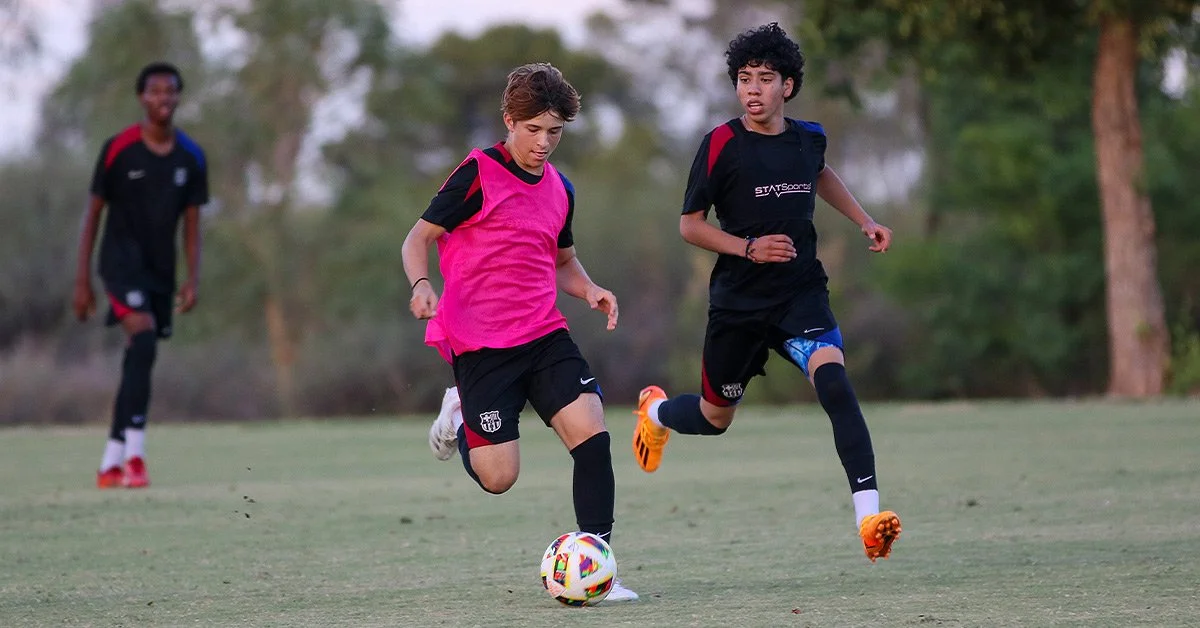
Small sided games to practice 1v1 in game-realistic scenarios.
In my sessions, I follow a progression:
Stage 1 — Learn the move. Unopposed, slow, focused on technique. Getting the footwork and body shape right without any pressure.
Stage 2 — Add passive pressure. A defender who's present but not fully committed — they give a direction, they close space, but they're not trying to win the ball. This is where the player learns timing and distance.
Stage 3 — Live 1v1s. Full competition. The defender is trying to stop you. This is where you find out whether the move actually works under pressure, and where the player starts to develop the instinct for when to use it.
Stage 4 — Small-sided games. 2v2, 3v3 — game-realistic scenarios where 1v1 situations emerge naturally. The player has to recognise the opportunity, choose the right move, and execute it with teammates and opponents around them. This is where the skill transfers to match play.
Ready to Work On Your 1v1 Game?
If your child wants to develop the skills to beat defenders, structured private coaching is the fastest way to get there. In my sessions, we build the technique, the decision-making, and the confidence to use skills at the right times in games.
I offer a free trial session so you can see the difference first-hand. Get in touch to book yours, or visit cdprivatesoccercoaching.com.au to learn more.