
Is Private Soccer Coaching Worth It? An Honest Breakdown for Parents
If you're reading this, you're probably weighing up whether private soccer coaching is worth the investment for your child. It's a fair question — and one I get asked by parents almost every week. Let me give you an honest answer, from someone who has coached over 1,500 private sessions and has been on all sides of this equation: as a player, a team coach, a private coach, and a professional scout (well, almost all sides — not a parent yet).
My short answer: yes — but with important caveats. Private coaching is not a magic fix. It's not a replacement for team training. And it won't turn every player into an academy prospect. But when it's done well, it can accelerate a player's development in ways that team training alone simply cannot. Let me explain why.
Key Takeaways
Private soccer coaching accelerates development but works best as a complement to team training, not a replacement
In a typical team session, roughly 30% of time is spent inactive — private coaching eliminates this with targeted, high-repetition work
Confidence is just as important as technique — players who believe in their ability perform better, and private coaching builds both
The player's attitude and willingness to learn matters more than any other factor in determining results
Small group sessions (2–5 players) bridge the gap between 1-on-1 technical work and game-realistic pressure
Results are real and measurable — players get moved up into better teams, earn academy offers, and develop a completely different approach to the game
What the Team Environment Does Well (And Where It Falls Short)
Team training and games are essential. They teach players how to function within a system — spacing, communication, positional play, decision-making in a game context, and the demands of competing against players of a similar level. No amount of private coaching replaces this. After all, football is a team sport played against an opposition. It's important not to lose sight of that.

But here's the reality that most parents don't see from the sideline: in a typical team session with 20+ players and one or two coaches, each player gets a fraction of the individual attention they need. Research on youth coaching sessions found that roughly 30% of session time is spent with players inactive — standing in lines, listening to instructions, or waiting for their turn (O'Connor et al., 2018, published in the Journal of Sports Sciences). That's not a criticism of team coaches — it's just the nature of managing a large group.
In that environment, a coach can't spend 10 minutes working on one player's first touch, or adjust a session in real time because a specific player is struggling with receiving on the half-turn. They're coaching the team, not the individual. I've been on that side — and despite my best efforts to give each player the attention they needed, I found it impossible.
That's exactly where private coaching fills the gap, and it's the reason I switched my focus to individual development. It gives me the best chance to truly help each player reach their footballing potential. When you consider that a player might get around 300-500 touches of the ball in a typical team session – most of which are only passively observed – compared to 2,000-3,000+ per session with us, where every touch is actively watched and any issues are immediately addressed, the difference becomes clear.
What Private Soccer Coaching Can Actually Do
Private coaching gives a player something that team training structurally cannot: undivided attention, immediate feedback, and high-volume repetition targeted at exactly what that player needs to improve.
In a 1-on-1 session, every single repetition is purposeful. We can zero in on foundational areas like ball mastery — where consistent, high-quality repetition is what allows players to become comfortable and in control of the ball — or focus on specific weaknesses, like a player’s weak foot passing, and spend an entire session on it with real-time correction on technique, body shape, and foot position. In a team setting, that same player might get three or four touches on their weak foot across a 90-minute session, with no specific feedback at all.
This is backed by research in skill acquisition. Studies consistently show that a lack of varied, individualised practice leads to stagnation — players who only train in the predictable environment of team drills and games eventually stop improving specific technical skills. The personalised, high-repetition environment of private coaching directly addresses this.
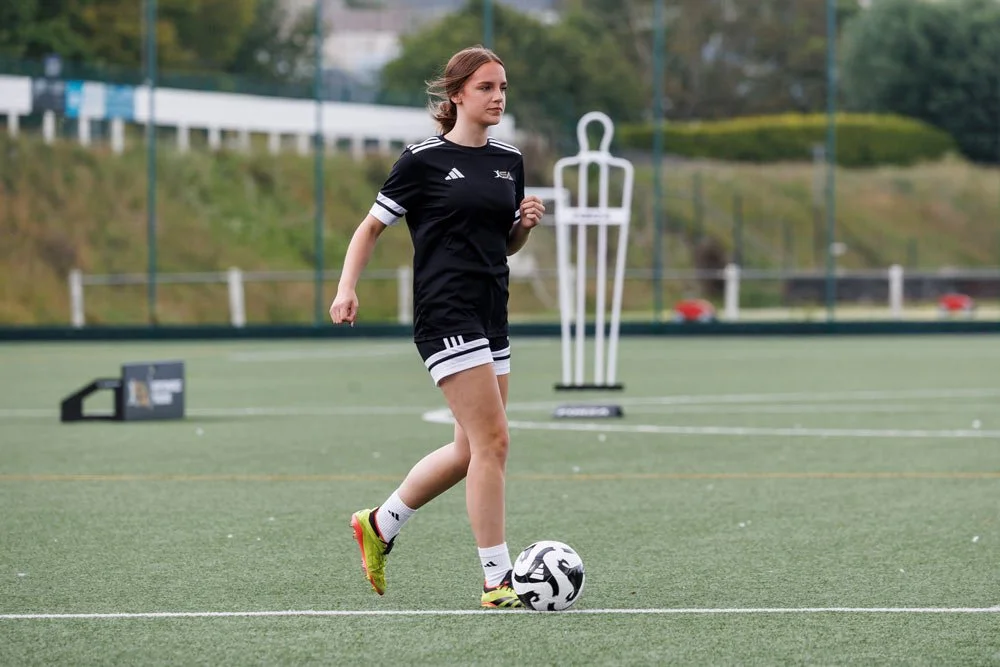
There's also a confidence factor that parents often underestimate. Young players know when they're behind in a certain area. They feel it in games and they feel it in comparison to teammates. Private coaching gives them a space to improve without the pressure of group comparison — and as their skills improve, their confidence grows with it. That confidence then carries directly into their team performances.
It's amazing how often I see players jump in ability and performance within the space of just one or two months. While the technical improvements are significant, the shift in confidence is just as important. Players start to believe they can be more than the comfort zone they've been sitting in.
One thing I can't stand is the pigeon-holing of young players. A kid gets told they're slow, as if that's a permanent condition. Or that they don't have a good shot. Or a poor weak foot. Or they're no good at 1v1s. These labels stick — and worse, the player starts to believe them. But when you can show a player that these "weaknesses" are fixable, and then actually fix them, the confidence that gives them is enormous. It changes how they carry themselves on the pitch.
I regularly work with players who have hit a plateau — trying to break through to the next level, whether that’s community to NPL, NPL to an A-League academy, or ultimately the professional game. But after a few weeks together, they're a different player. Not just technically, but in their mentality. They see the game differently. They work harder. They're more confident. They're excited to keep pushing. And that progress becomes addictive — for the player, for the parent, and honestly, for me too.
What Private Soccer Coaching Can't Do
I want to be upfront about this, because too many coaches oversell what private training can achieve.
Private coaching cannot replicate the unpredictability of a real game. It can't teach a player how to communicate with ten teammates in real time, or how to deal with the pressure of a match situation with parents watching from the sideline. It can't build the spatial awareness that comes from playing in a full-sized game with 22 players on the pitch.
It's actually not uncommon for players to start wanting more and more private sessions after training with me for a while. That's fine to an extent — but if you're a player or parent of a player I work with, you'll know the emphasis I put on team training (thus choosing a good team environment is critical), games, and other competitive exposures like tournaments and futsal competitions (see my post on how often you should be training to hear more about this). The whole point of private coaching is to make you better so you can excel in those environments. We need to make sure we're constantly taking our learnings to the real environment and applying them there.
Private coaching also relies on the player involved. That is to say, it can't help you if you are not willing to be helped. I am very strong on this: if the player wants to be there, is willing to be coached, and shows respect — to the coaches, to fellow players, to the equipment, to their parents for bringing them — then they will become a better player. Full stop. And the better the attitude, the faster they'll improve. Time and again I find that the player's attitude and willingness to learn is the single biggest factor in whether private sessions translate into real improvement.
Ultimately, private coaching should be seen as a complement to team training, not a replacement. The two work together — private sessions build the individual tools, and team training gives the player the environment to apply them.
Why Small Group Sessions Bridge the Gap
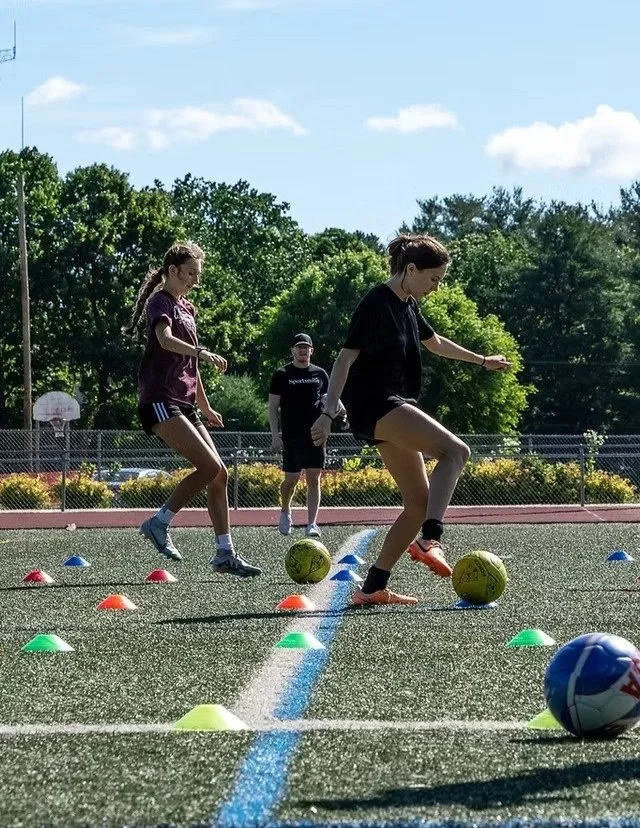
Small group soccer training session.
One of the most common — and valid — criticisms of 1-on-1 coaching is that it lacks the competitive, game-realistic element of team play. A player can look brilliant in an unopposed drill but struggle to transfer those skills into a match.
This is exactly why we offer small group sessions of 2–5 players alongside 1-on-1 coaching. These sessions maintain the high coaching attention and targeted development of private training, but add the competitive pressure that 1-on-1 work can't provide — 1v1 duels, small-sided scenarios (1v2, 2v2, 2v3, etc.), and game-realistic situations where players have to execute their skills against real opposition.
Something that sets our sessions apart is the coaches' direct participation. Whether it's a 1-on-1 or a group session, I'm not standing on the side telling players what to do — I'm in there with them. Doing drills directly with the players, driving the standard, demanding more speed, firmer passes, higher pressure. The purpose is to show the players the level that's required and to make sure they're rising above what they previously thought was good enough. When a player has to compete against a coach who's pushing them, they're forced to play at a higher speed and intensity than they're used to — and that's where real growth happens.
The combination of 1-on-1 technical work and small group competitive sessions is, in my experience, the most effective development model for young players. It builds the skills and then pressure-tests them — so when a player goes into their weekend game, they've already been challenged at a level that makes the match feel manageable.
What Realistic Improvement From Private Coaching Actually Looks Like
Every player's development pathway is different. Some players make dramatic visible progress in 4–6 sessions. Others take longer because the work is more foundational — rebuilding habits, correcting ingrained technique, changing the way they think about the game. But across over 1,500 sessions, I have never had a player who hasn't improved significantly.
One example that stands out: I had a player come to us playing community-level soccer in the U14s (see ‘NPL v Community Soccer’). They had some ability but were playing at their level — nothing to suggest they were ready for anything higher. After six months of training together, the season ended and trials opened up for the following year. I urged them to trial at as many NPL clubs as they could — partly for the experience, but also because reaching that level had been our short-term goal and I was confident they'd comfortably risen to that standard. They trialled at five NPL clubs and were offered a spot at every single one. A year earlier, they hadn't received a single offer. A year on from that, they're captaining their team and we're pushing for the next level — A-League academies and beyond.
What private coaching allows us to do is not just let a player's strengths be strengths, but develop them into real weapons that stand out from the crowd (and be noticed by scouts). At the same time, we strategically address weaknesses to build a more complete player — and often uncover new strengths that the player never knew they had.
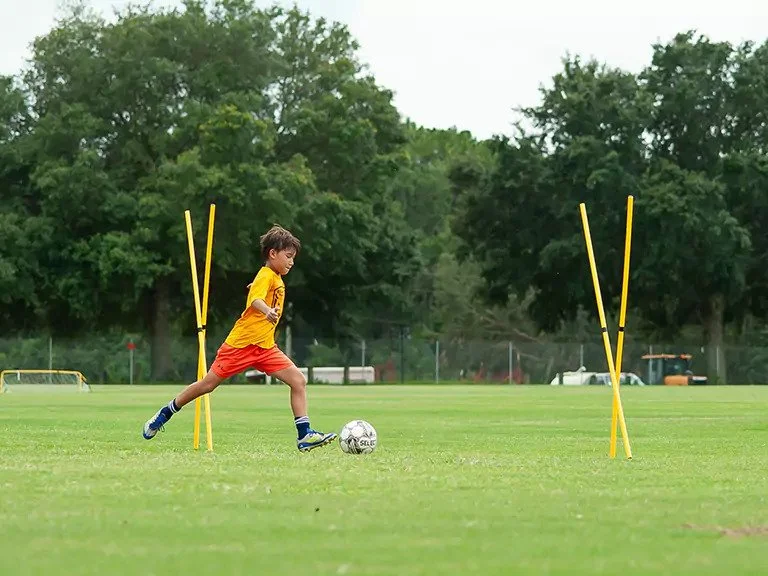
Youth soccer player working on long passing in a one-on-one session.
The results show up where it matters: in games. I regularly get parents telling me they saw their child do something they'd never done before — and when they asked about it, the player said, "Cam taught me that." That feedback is incredibly motivating for me, because it means the work is transferring from our sessions to the pitch on the weekend.
Coaches notice too. Players get moved up into better teams at their club mid-season. They go to trials at new clubs and suddenly find themselves getting into squads they previously had no chance at. We raise their level, their belief in their own ability, and as a result, the opinions of the people around them shift too.
And teammates? They're the most honest feedback loop of all. "Where have you been training?" "Where did you learn that?" "I used to be better than you." Kids don't hold back. But this is also where most of our new players come from — seeing first-hand how a teammate has improved makes them want to seek out the same coaching.
The improvement isn't just technical. What I find most rewarding is when a player's entire approach to football changes — how they prepare for training, how they think about their positioning, how they process the game while they're playing it. When you combine better technical ability with better football understanding, the player doesn't just improve — they start to dominate. And that visible progress, seen by the player themselves, their parents, and their coaches, is what drives continued development. The progress becomes addictive — and watching that transformation is the most satisfying part of my work, and the reason I moved from team coaching to focusing on individual development.
Is the Investment Worth It?
Private coaching is a real financial commitment — and I respect that. Every parent should weigh it up honestly based on their child's goals, their level of commitment, and what stage of development they're at.
What I will say is this: the players who get the most out of private coaching are those who are already in a team environment and want more. They're hungry to improve. They take the work seriously. And they — not just their parents — want to be there.
If that sounds like your child, the investment pays for itself through the confidence, skill development, and pathway opportunities that follow. Players I've worked with have gone on to earn places at Melbourne Victory Academy, Melbourne City Academy, Football Victoria Academy, Western United Academy, and the Emerging Matildas. Those doors opened because of targeted development that team training alone couldn't provide.
Try It Before You Commit
I offer a free trial session for exactly this reason — so you can see the difference first-hand before making any commitment. There's no pressure and no obligation. Just a session tailored to your child, so you can judge the value for yourself.
Get in touch to book yours, or visit cdprivatesoccercoaching.com.au to learn more.
Sources Referenced
O'Connor, D., Larkin, P., & Williams, A.M. (2018). What learning environments help improve decision-making? Journal of Sports Sciences, 36(18).